' /%3E%3Ctext x='16' y='23' font-family='Arial, sans-serif' font-size='30' font-weight='bold' fill='white' text-anchor='middle'%3EF%3C/text%3E%3C/svg%3E)
Lógica Dedutiva
Com base nestas 3 pistas críticas, quem tem o peixe? 1. O Britânico vive na casa vermelha. 2. O Sueco tem cães como animais de estimação. 3. O Alemão fuma Prince e é dono do peixe. Espere, a resposta está na pista! Mas consegue encontrar o dono se as pistas estiverem baralhadas?
O Enigma #1
Na verdade, vamos resolver uma parte real: O Britânico vive na casa vermelha. A casa verde está imediatamente à esquerda da casa branca. O dono da casa verde bebe café. Quem vive na casa verde?


Ação
Selecione a pessoa que vive na casa verde.
How To
Analise as restrições e as relações entre as casas, nacionalidades e hábitos. Elimine o impossível para encontrar o verdadeiro dono.
Share The Fun
Invite friends to take this challenge!
Sabia que?
O enigma é frequentemente atribuído a Albert Einstein, embora não existam provas de que ele o tenha escrito.
É um exemplo clássico de um 'Problema de Satisfação de Restrições' na ciência da computação.
Resolver isto requer 'lógica de grelha' onde elimina possibilidades até sobrar apenas uma.
Algumas versões do enigma usam diferentes nacionalidades ou marcas, mas a lógica permanece a mesma.
Can You Solve the 'Einstein Riddle'? Puzzle (Logic) - The Ultimate Brain Teaser
There is a riddle so difficult that Albert Einstein reportedly invented it as a child. He claimed only 2% of the world's population could solve it.
Whether that story is true or not, one thing is certain: The Einstein Riddle is one of the most famous logic puzzles ever created.
It's a test of pure deduction. No tricks. No wordplay. Just pure reasoning. And it's brutal.
Ready to take the challenge? Here it is.
The Einstein Riddle: The Setup
There are five houses lined up in a row. Each house has a different color. In each house lives a person of a different nationality. Each person drinks a different beverage, smokes a different brand of cigar, and owns a different pet.
You are given 15 clues. Your task is to determine: Who owns the fish?
Note: In the original riddle, it's a fish. Some versions use a zebra or a different pet. But the puzzle structure remains identical.
The Clues
Here are all 15 clues. Read them carefully. Take your time. Some clues are direct. Others are indirect. All are essential.
- The Brit lives in the red house.
- The Swede keeps dogs as pets.
- The Dane drinks tea.
- The green house is immediately to the left of the white house.
- The green house owner drinks coffee.
- The person who smokes Pall Mall rears birds.
- The owner of the yellow house smokes Dunhill.
- The man living in the center house drinks milk.
- The Norwegian lives in the first house.
- The person who smokes Blends lives next to the one who keeps cats.
- The person who keeps horses lives next to the one who smokes Dunhill.
- The person who smokes Blue Master drinks beer.
- The German smokes Prince.
- The Norwegian lives next to the blue house.
- The person who smokes Blends has a neighbor who drinks water.
The Question
Who owns the fish?
Think Before You Scroll
This puzzle is hard. Really hard. It typically takes 20-30 minutes to solve—if you're good at logic. Some people take hours.
If you want to solve it yourself, take the following steps:
- Get a piece of paper and a pen
- Draw a grid: 5 columns for houses, rows for attributes
- Fill in what you know for certain
- Eliminate what's impossible
- Use logic to deduce the rest
When you're ready—or if you're completely stuck—scroll past the warning below for the solution.
⚠️ SPOILER ALERT ⚠️
The solution is revealed below. If you want to solve it yourself, stop here.
The Solution: Who Owns the Fish?
The German owns the fish.
Let's break down the full solution.
The Complete Grid
| House | 1 | 2 | 3 | 4 | 5 |
|---|---|---|---|---|---|
| Color | Yellow | Blue | Red | Green | White |
| Nationality | Norwegian | Dane | Brit | German | Swede |
| Beverage | Water | Tea | Milk | Coffee | Beer |
| Cigar | Dunhill | Blends | Pall Mall | Prince | Blue Master |
| Pet | Cats | Horses | Birds | Fish | Dogs |
Step-by-Step Deduction
Here's how you arrive at the solution, step by step.
Step 1: Start with What's Certain
- From clue 9: Norwegian lives in House 1
- From clue 8: House 3 drinks milk
- From clue 14: Norwegian lives next to blue house → House 2 is blue
Step 2: Place the Green and White Houses
- Clue 4: Green is immediately left of White
- Green cannot be House 1 (House 2 is blue) or House 5
- Green cannot be House 3 (House 3 drinks milk, Green drinks coffee from clue 5)
- Therefore: Green = House 4, White = House 5
- House 4 drinks coffee (clue 5)
Step 3: Place the Red House and Brit
- House 1 = Yellow (clue 7: yellow smokes Dunhill)
- House 2 = Blue
- House 4 = Green
- House 5 = White
- House 3 must be Red → Brit lives there (clue 1)
Step 4: Place the Dane
- Clue 3: Dane drinks tea
- House 1 drinks water? Not yet known
- House 2 must be Dane who drinks tea (House 4 drinks coffee, House 3 drinks milk, House 5 remains)
Step 5: Place the Cigars
- House 1 (Yellow) smokes Dunhill (clue 7)
- House 1 is Norwegian
- Clue 11: Horses next to Dunhill → House 2 has horses
- Clue 10: Blends next to cats
- Clue 15: Blends next to water
- This forces Blends into House 2
- House 2 now: Blue, Dane, Tea, Blends, Horses
Step 6: Place Remaining Cigars and Nationalities
- Clue 13: German smokes Prince → German cannot be House 1, 2, 3 (Brit), or 5 (Swede), so German = House 4
- House 4 = Green, Coffee, German, Prince
- Clue 12: Blue Master drinks beer → House 5 = Swede, Beer, Blue Master, Dogs (clue 2)
- Remaining cigar for House 3: Pall Mall → rears birds (clue 6)
- House 3 = Red, Brit, Milk, Pall Mall, Birds
Step 7: Determine the Pet
- House 2 has horses
- House 3 has birds
- House 5 has dogs
- House 1 must have cats (Blends is next to cats, House 1 is next to House 2 which has Blends)
- House 4 gets the remaining pet: Fish
Therefore, the German in House 4 owns the fish.
Why This Puzzle Is So Effective
The Einstein Riddle isn't just a game. It's a perfect test of logical reasoning.
What Makes It Difficult
- Multiple variables: 5 categories × 5 attributes each = 25 pieces of information
- Interlocking clues: Every decision affects multiple categories
- No trial-and-error: You must deduce logically. Guessing won't work.
- One correct answer: There is no ambiguity. Only one arrangement satisfies all clues.
What It Tests
- Working memory: You must hold multiple facts in your head simultaneously
- Pattern recognition: You must see connections between unrelated clues
- Elimination: You must identify impossible combinations
- Systematic thinking: You must follow a method, not rely on intuition
Visualizing the Solution
Sometimes seeing the full arrangement helps.
House 1
Yellow
Norwegian
Water
Dunhill
Cats
House 2
Blue
Dane
Tea
Blends
Horses
House 3
Red
Brit
Milk
Pall Mall
Birds
House 4
Green
German
Coffee
Prince
Fish 🐟
House 5
White
Swede
Beer
Blue Master
Dogs
Frequently Asked Questions About the Einstein Riddle
Did Einstein actually create this riddle?
Probably not. The riddle was likely created in the 1960s and attributed to Einstein to make it more famous. But the myth persists because it's a great story.
Is it true only 2% of people can solve it?
That number is made up. But the puzzle is genuinely difficult. Most people can't solve it quickly or without help.
Can I solve it without writing anything down?
Almost certainly not. This puzzle requires systematic elimination. Writing a grid is essential.
Are there other versions of this puzzle?
Yes. There's a "Zebra Puzzle" version with different attributes. There are also simplified 3-house versions and harder 6-house versions.
What's the fastest way to solve this puzzle?
Use a grid. Start with definite placements. Then systematically eliminate possibilities. Don't jump ahead. Be patient.
Your Turn: Master the Method
You've seen the solution. Now try another version.
Alternative Puzzle: The Zebra Riddle
Use the same structure but change the categories:
- 5 houses with 5 different colors
- 5 owners with 5 different nationalities
- 5 different drinks
- 5 different hobbies
- 5 different pets
The method is identical. The details change. The logic remains.
The real value of this puzzle isn't the answer. It's the process. Learning to break down complex problems into manageable steps. Learning to eliminate what's impossible. Learning to think systematically.
Those skills will serve you long after you've forgotten the answer to this riddle.
Now go solve something hard. You've earned it.
Explore More Fun

Qual 'caminho' é o mais seguro?

Resolva esta porta lógica 'Verdade ou Desafio'
Quale 'Sombra' appartiene all'oggetto?
Consegues consertar esta 'Sequência Quebrada'?

Qual 'Interruptor' liga a lâmpada?
Quem é o 'Dono' do cão desaparecido?
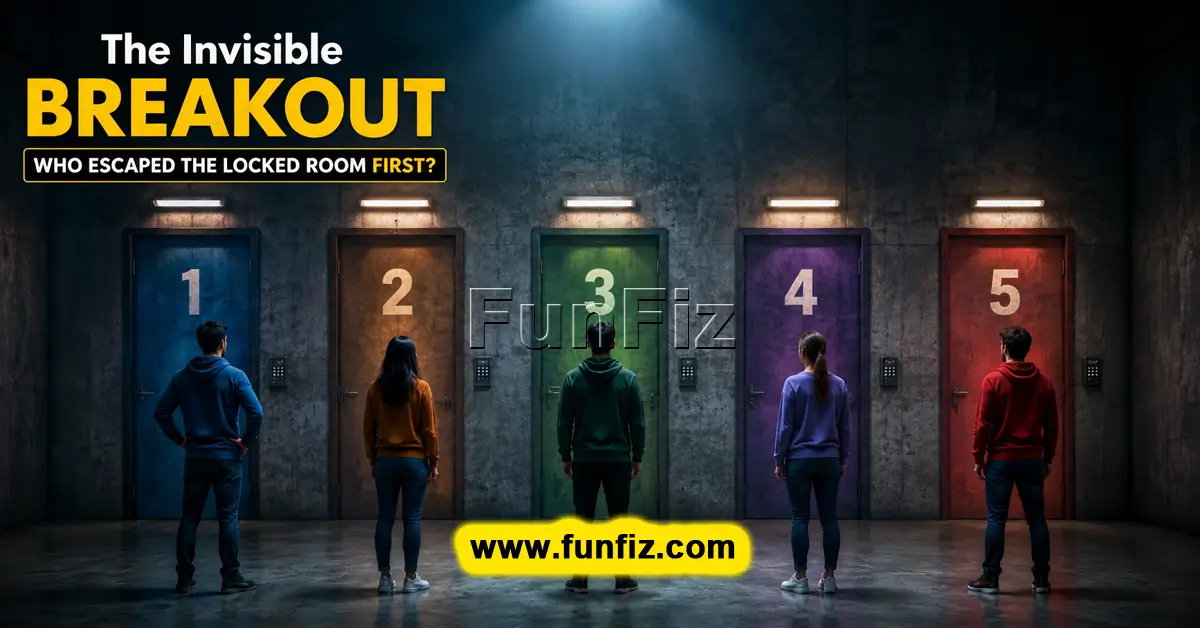
Quem 'escapou' da sala trancada primeiro?

Quem é o 'Médico Verdadeiro' nesta foto?
