' /%3E%3Ctext x='16' y='23' font-family='Arial, sans-serif' font-size='30' font-weight='bold' fill='white' text-anchor='middle'%3EF%3C/text%3E%3C/svg%3E)
Share The Fun
Invite friends to take this challenge!
Did You Know?
Your nose can remember 50,000 different scents.
The human heart creates enough pressure to squirt blood 30 feet.
You lose about 50-100 hairs every single day.
Your bones are stronger than steel (pound for pound).
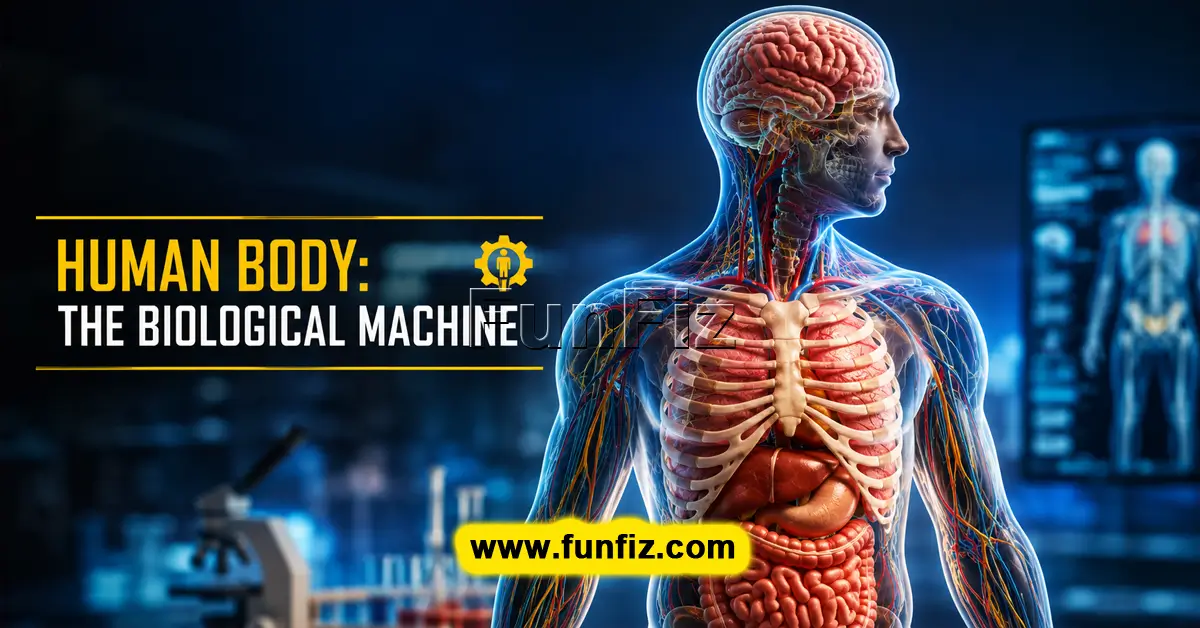
Human Body: The Biological Machine - How Your Body Really Works
Look at your hand. Move your fingers. Feel your heart beating. Blink your eyes. All of this happens automatically, without you thinking about it.
Your body is the most complex machine ever created. No supercomputer can match it. No robot can replicate it. And yet, most of us have no idea how it actually works.
This is your guide to the human body—the biological machine that keeps you alive, moving, and thinking. No medical jargon. No boring textbooks. Just the facts about the incredible system that is you.
The Brain: Your Body's Command Center
Your brain is the most powerful organ in your body. It controls everything—your thoughts, your movements, your emotions, and even your heartbeat. And it does all this using electricity and chemicals.
How the Brain Works
- Your brain contains about 86 billion neurons (nerve cells)
- Each neuron connects to thousands of others, creating 100 trillion connections
- Signals travel through your brain at speeds up to 430 kilometers per hour
- Your brain uses about 20% of your body's oxygen and energy
- Despite all this power, your brain weighs only about 1.4 kilograms
Brain Facts That Will Blow Your Mind
- You generate enough electricity in your brain to power a small light bulb
- Your brain can store the equivalent of 2.5 million gigabytes of data
- The brain has no pain receptors—you can't feel pain inside your brain
- Your brain is 73% water—dehydration of just 2% affects your cognitive performance
- While awake, your brain produces enough electricity to light a 25-watt bulb
The Heart: The Engine That Never Sleeps
Your heart works harder than any muscle in your body. It beats about 100,000 times a day, pumping blood through 100,000 kilometers of blood vessels. That's enough to circle the Earth twice.
What Your Heart Does Every Day
- 10,000+ liters of blood pumped daily
- 60-100 beats per minute at rest
- 2.5 billion beats in an average lifetime
- Blood travels 19,000 kilometers through your circulatory system each day
- A heart beats 35 million times in a year
What Happens When Your Heart Pumps
Your heart has four chambers. Blood enters the right atrium, flows to the right ventricle, then goes to the lungs to get oxygen. It returns to the left atrium, flows to the left ventricle, and is pumped to the rest of your body.
This cycle repeats every second of your life. No breaks. No holidays. Just non-stop work.
The Lungs: Your Internal Air Exchange
Your lungs are designed for one job: exchanging oxygen and carbon dioxide. They do this 20,000 times a day without you even noticing.
- Your lungs contain about 1,500 kilometers of airways
- At rest, you breathe 12-20 times per minute
- You inhale about 11,000 liters of air daily
- If spread flat, the surface area of your lungs would cover a tennis court
- Your right lung is slightly larger than your left (to make room for your heart)
The Skeleton: Your Internal Framework
You have 206 bones in your body. They support you, protect your organs, and allow you to move. And they're constantly renewing themselves.
Skeleton Facts
- Bones are stronger than steel (pound for pound)
- Your skeleton replaces itself completely every 10 years
- The longest bone is the femur (thigh bone)—about 48 cm long
- The smallest bone is the stapes (in your ear)—only 3 mm long
- You have 14 bones in your face and 26 bones in each foot
- Babies have 300 bones—some fuse together as they grow
The Muscles: Your Body's Motors
You have over 600 muscles in your body. They allow you to move, speak, breathe, and even smile. Some you control consciously. Others work automatically.
Types of Muscles
- Skeletal muscles: You control these (like biceps). They move your bones.
- Smooth muscles: You don't control these. They line your organs and blood vessels.
- Cardiac muscle: Only in your heart. It never gets tired.
Muscle Facts
- The strongest muscle (relative to size) is the masseter (jaw muscle)
- The hardest working muscle is the heart
- You use 200 muscles just to take one step
- You use 43 muscles to frown and 17 muscles to smile—smiling is easier!
- Muscles make up about 40% of your body weight
The Digestive System: Your Body's Refinery
Your digestive system is a 9-meter tube that processes everything you eat. From the moment food enters your mouth to the moment it leaves, your body extracts every bit of energy it can.
The Digestive Journey
- Mouth: Chewing breaks food down. Saliva starts chemical digestion.
- Stomach: Acid and enzymes break food into a liquid.
- Small intestine: Nutrients are absorbed into the bloodstream.
- Large intestine: Water is absorbed. Waste is formed.
- Rectum: Waste is stored until elimination.
Digestive Facts
- You produce about 1.5 liters of saliva daily
- Your stomach acid is strong enough to dissolve razor blades
- Food takes 6-8 hours to pass through your stomach and small intestine
- Total digestion takes 24-72 hours
- You have 100 trillion bacteria in your gut—they help you digest
The Immune System: Your Body's Defense Force
Your immune system is a army of cells and proteins that defends you against invaders—viruses, bacteria, parasites, and more. It remembers threats so it can fight them faster next time.
How Your Immune System Fights
- White blood cells travel through your body looking for threats
- Antibodies neutralize specific invaders
- Your immune system remembers every invader it has fought
- This is why vaccines work—they train your immune system
- Your immune system fights millions of threats every day
Human Body Comparison Table
| System | Components | Main Job | Fun Fact |
|---|---|---|---|
| Nervous | Brain, spinal cord, nerves | Controls everything | Signals travel at 430 km/h |
| Circulatory | Heart, blood, vessels | Transports oxygen and nutrients | 100,000 km of blood vessels |
| Respiratory | Lungs, trachea, diaphragm | Exchanges oxygen and CO2 | Lungs cover a tennis court |
| Skeletal | 206 bones, joints | Supports and protects | Bones stronger than steel |
| Muscular | 600+ muscles | Enables movement | 40% of body weight |
| Digestive | 9-meter tube, organs | Breaks down food | Stomach acid dissolves metal |
Frequently Asked Questions About the Human Body
How many cells are in the human body?
About 37 trillion. You replace about 330 billion cells every day. That means by the time you finish reading this, millions of your cells will have died and been replaced.
What is the strongest muscle in the human body?
The masseter (jaw muscle) is the strongest by size. But the gluteus maximus (buttocks) is the largest and generates the most force.
What is the largest organ in the body?
The skin. It covers about 2 square meters and weighs around 4-5 kilograms. It's your first line of defense against disease.
How much blood is in the human body?
About 5 liters for an average adult. That's enough to fill a large bottle of soda. It circulates through your body every minute.
How many times does the heart beat in a lifetime?
About 2.5 billion times. It beats around 100,000 times per day, 35 million times per year, and never stops until you die.
What percentage of the body is water?
About 60% for adults. Babies are about 75% water. This water is essential for every single bodily function.
Your Body is a Masterpiece
The human body is an engineering marvel. Billions of cells working together. Trillions of chemical reactions happening every second. Systems that never stop, never rest, never take a day off.
You don't have to be a doctor to appreciate it. You just have to pay attention.
Next time you take a breath, feel your heartbeat, or blink your eyes, remember: you are walking through life inside a machine that has been perfected over millions of years of evolution.
And it's all yours.
Take care of it. It's the only one you'll get.
Explore More Fun
The Periodic Table: Elements of Surprise

Earth’s Ecosystem: Climate and Nature

Green Science: Climate Change & Renewable Energy
Physics Phenomena: Gravity, Time, and Light
Cosmos Quest: Planets, Stars, and Black Holes
Genetic Code: Secrets of DNA Challenge